

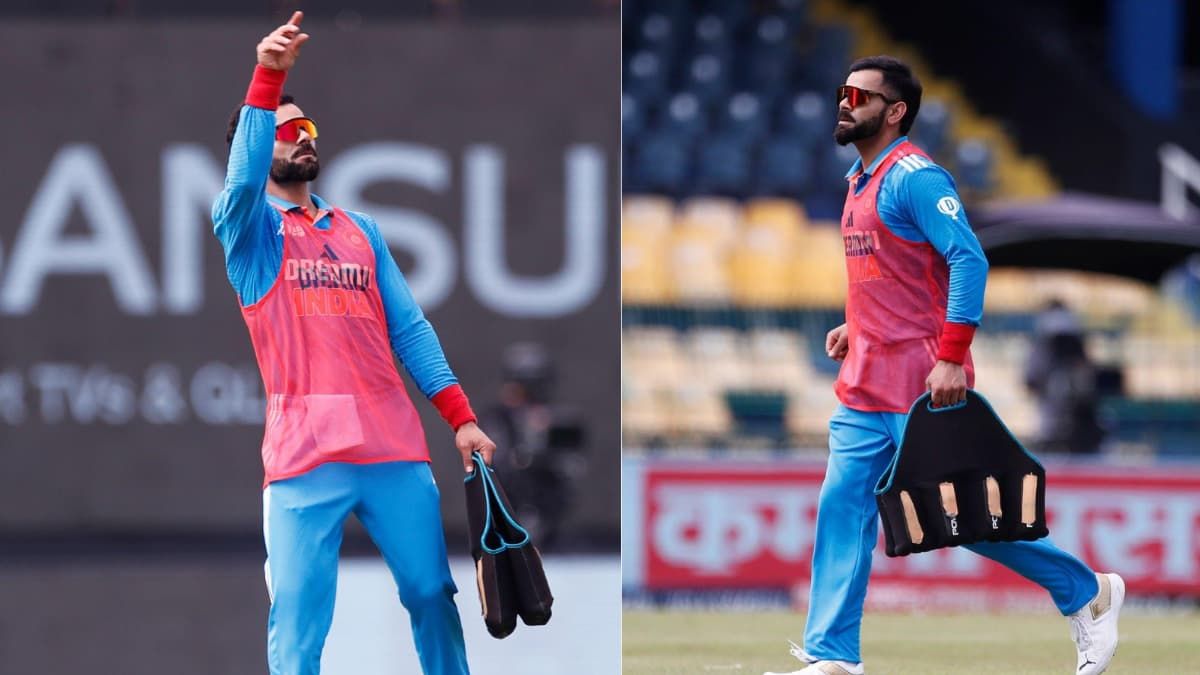
Cricket teams nominate 11 players for a match, but you may often see another player running onto the field with drinks, carrying equipment or replacing an injured fielder. This player is commonly known as the 12th man in cricket.
The 12th man plays an important supporting role. They can help the team during long spells in the field and may even influence a match through a crucial catch or run out. However, cricket rules place clear limits on what an ordinary substitute fielder can do. They cannot simply enter the game and bat or bowl whenever the captain needs them.
The role has also evolved. Modern international cricket allows teams to nominate several substitute fielders, while special rules cover concussion replacements. The October 2026 ICC Playing Conditions also allow the Head Coach or their designate to consult on-field players during scheduled drinks intervals in ODIs and T20Is.
Here is how the 12th man role works, what the player can and cannot do, and how cricket rules treat substitutes and special replacements.
What Is the 12th Man in Cricket?
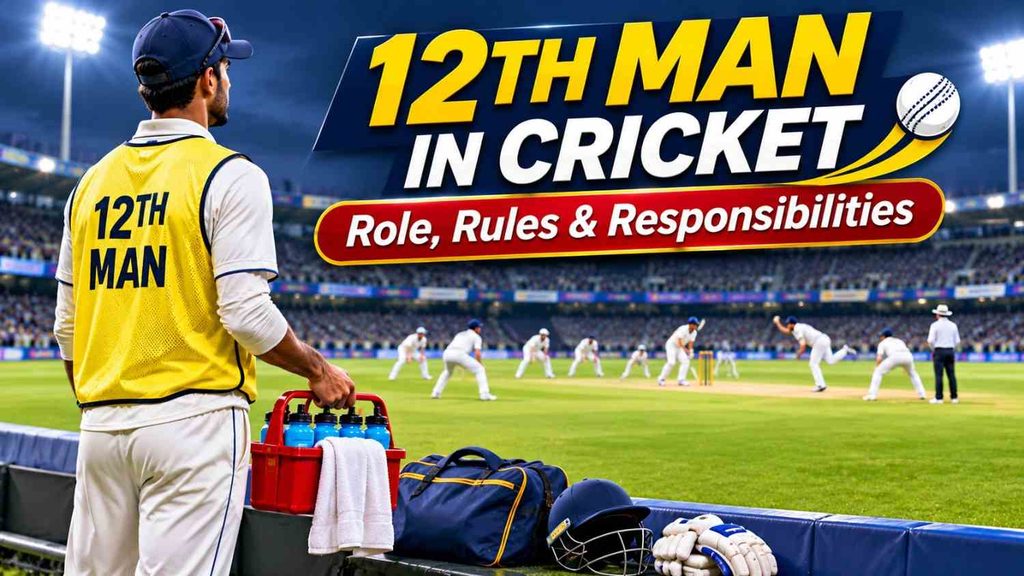
The 12th man is a reserve player outside the starting playing XI who can support the team during a match. The term traditionally refers to a substitute fielder who temporarily replaces an absent or injured player on the field.
A cricket team nominates 11 players for a match. When one team is fielding, its 11 players are on the field, while two batters from the opposing team are at the crease. A substitute fielder may temporarily take the place of an eligible absent fielder when the umpires allow it.
The term is widely used in international, domestic and club cricket. However, the official Laws use the term substitute fielder, rather than treating the 12th man as a separate playing position.
The 12th man is not necessarily the only reserve player in a modern team. Competition regulations can allow teams to nominate several substitute fielders.
For example, the ICC Men’s T20 World Cup 2026 Playing Conditions allowed each team to nominate 11 players and a maximum of four substitute fielders. This was a competition-specific provision, not a universal rule for every cricket match.
What Are the Main Responsibilities of the 12th Man?
The 12th man has practical and supporting responsibilities. Some duties happen during breaks, while others involve direct participation in the field.
1. Acting as a Substitute Fielder
This is the most important official role. If a playing XI member becomes injured or ill during a match, the team can request a substitute fielder.
Once the umpires approve the request, the substitute can take the absent player’s place in the field. They can stop boundaries, collect the ball, throw it to the wicketkeeper and attempt catches or run outs.
A good substitute fielder can make a genuine difference. A sharp catch or accurate throw can change the result of a close match.
2. Bringing Drinks and Equipment
The 12th man may typically carry drinks to players during authorised breaks. They may also bring gloves, bats, helmets or other equipment when requested, subject to the competition’s playing conditions and the umpires’ instructions.
A player may be given a drink at the boundary edge or, where permitted, on the field. Other drinks should not be taken onto the field without the umpires’ permission.
This support is particularly useful during long Test matches, when players spend several hours in the field.
3. Relaying Messages
The 12th man may sometimes carry permitted messages between the dressing room and players on the field. These can include information about an injury or messages from the coaching staff, subject to the applicable match regulations.
However, the 12th man is not the only person who can communicate with players during a scheduled drinks interval.
Under the October 2026 ICC Men’s ODI and T20I Playing Conditions, the Head Coach or their designate may enter the field of play during scheduled drinks intervals to consult on-field players for tactical reasons.
This permission applies to the specified drinks intervals. It does not give coaching staff unrestricted access to the field throughout the match.
The substitute does not have the authority to make decisions as captain. The captain remains responsible for the team’s on-field decisions.
4. Supporting Injured Players
The 12th man can help an injured teammate leave the field and provide practical support when required. The substitute may then take over that player’s fielding position, subject to the umpires’ approval.
This helps the team maintain its fielding strength while the injured player receives attention.
What Can the 12th Man Do in Cricket?
The 12th man’s permitted activities depend on whether the player is acting as an ordinary substitute or has been approved under a special replacement rule.
Under the standard substitute-fielder rules, an ordinary substitute’s activities are limited to fielding.
| Activity | Can the 12th man do it? |
| Field in place of an absent player | Yes, with umpire approval |
| Take a catch | Yes |
| Stop a boundary | Yes |
| Complete a run out | Yes |
| Bring drinks and equipment | May do so as team support, subject to match regulations |
| Relay messages | Only as permitted by match regulations |
| Bowl | No, as an ordinary substitute |
| Bat | No, as an ordinary substitute |
| Act as captain | No |
| Keep wicket | Only with the umpires’ consent |
These restrictions prevent a team from gaining an unfair advantage by bringing in a fresh batter or bowler through an ordinary fielding substitution.
What Are the Rules for the 12th Man in Cricket?
The rules are explained under Law 24 of the MCC Laws of Cricket, which covers a fielder’s absence and substitutes. The applicable ICC or domestic competition playing conditions may add specific provisions or variations.
1. When Is a Substitute Fielder Allowed?
The umpires must be satisfied that a player became injured or ill during the match, or that another wholly acceptable reason exists.
A team cannot use a substitute simply because it wants a better fielder in a particular position. A tactical change alone does not qualify as a valid reason.
The substitute must also be approved by the umpires before taking the field.
2. Can the 12th Man Bat or Bowl?
No. An ordinary substitute fielder cannot bat or bowl. The player also cannot act as captain.
Only a nominated player can bat or bowl under the standard rules. A substitute may keep wicket only if the umpires give permission, subject to the relevant Laws and playing conditions.
Special replacements, such as approved concussion replacements, are different and can participate as full players.
3. Can the Original Player Return?
Yes. Once the absent player is ready to return, they can come back with the umpire’s permission.
The substitute then leaves the field. However, the original player’s absence may affect when they can bowl or bat after returning because of penalty-time restrictions.
4. What Is Penalty Time?
Penalty time is the period a nominated player may have to serve after being absent from the field before they can resume certain duties.
Under the current men’s international playing conditions, the restrictions generally apply when a player is absent for longer than eight minutes.
The player may be restricted from bowling until the required playing time has been served. Unserved penalty time can also affect when the player is allowed to begin batting.
The maximum unexpired penalty time depends on the format:
| Match format | Maximum unexpired penalty time |
| Men’s Test cricket | 120 minutes |
| Men’s ODI cricket | 120 minutes |
| Men’s T20I cricket | 40 minutes |
These are the limits in the October 2026 ICC men’s playing conditions. A particular tournament or domestic competition may have its own playing conditions, so the relevant match regulations should always be checked.
A player with unserved penalty time may generally start batting once their team has lost five wickets, even if the penalty time has not completely expired.
There are exceptions. A player does not incur penalty time when their absence is due to an external blow received during the match. Penalty time may also not apply when the umpires consider another reason for the absence wholly acceptable, provided it is not illness or internal injury.
Penalty time can carry over. If unserved penalty time remains at the end of an innings, it carries forward into the next and subsequent innings under the applicable playing conditions. In multi-day matches, the outstanding balance does not simply disappear when the day’s play ends.
Teams must follow the rules applicable to their particular match. The October 2026 ICC Playing Conditions apply to international series starting on or after 1 October 2026. Series already in progress on that date continue under their previous regulations.
12th Man vs Concussion Substitute: What Is the Difference?
A common misunderstanding is that every substitute is treated in the same way. That is not correct.
An ordinary substitute fielder temporarily takes the place of an absent fielder. They do not replace that player on the team’s list of nominated players.
A concussion replacement is different. Under ICC playing conditions, a team can request an approved replacement when a player suffers a concussion or suspected concussion during a match.
Pre-Named Concussion Replacement Players
The ICC introduced changes to its concussion replacement process in 2025. Under the men’s international arrangements, teams must nominate their designated concussion replacement options before the match.
The five replacement roles are:
- One wicketkeeper
- One batter
- One all-rounder
- One seam bowler
- One spin bowler
The nominated replacement must ordinarily come from the team’s pre-submitted list. The Match Referee may consider a player outside that list in exceptional circumstances, applying the like-for-like replacement requirements.
The five roles describe the categories of replacement options. They should not be confused with permission to select any player freely from the squad after an injury.
How Is a Concussion Replacement Approved?
Under the relevant ICC playing conditions, the concussion or suspected concussion must be formally assessed and diagnosed by the Team Medical Representative.
The team must submit a replacement request to the Match Referee. The proposed replacement should ordinarily be a like-for-like player.
The Match Referee considers the role the injured player would have performed and whether the replacement would give the team an excessive advantage. The referee can impose restrictions if necessary.
Once approved, the replacement becomes a nominated player and can participate as a regular player, subject to any restrictions imposed by the Match Referee. The original player takes no further part in the match.
| Feature | Ordinary substitute | Concussion replacement |
| Main purpose | Temporarily cover an absent fielder | Replace a player with a diagnosed or suspected concussion under the rules |
| Approval | Umpires | Match Referee |
| Assessment | No concussion assessment required for an ordinary substitute | Team Medical Representative assesses and diagnoses the concussion or suspected concussion |
| Replacement type | Substitute fielder | Ordinarily a like-for-like player from the nominated list |
| Can bat | No | Yes, subject to approval conditions |
| Can bowl | No | Yes, subject to approval conditions |
| Can field | Yes | Yes |
| Status in nominated team | Does not replace the nominated player | Becomes a nominated player |
The distinction is important. A concussion replacement is not simply another name for the 12th man, and approval is not automatic.
Famous 12th Man Moments in Cricket
Although substitute fielders have limited powers, they have produced some memorable moments in cricket history.
Gary Pratt’s Run Out of Ricky Ponting in the 2005 Ashes
One of the best-known substitute fielding moments happened during the 2005 Ashes series between England and Australia.
England’s Gary Pratt was fielding as a substitute when he produced a direct hit to run out Australian captain Ricky Ponting at Trent Bridge during the fourth Test.
Ponting had to leave after a score of 48. The dismissal attracted considerable attention because it came from a substitute fielder rather than a member of England’s starting XI.
Pratt’s throw became one of the defining fielding moments of that famous Ashes series.
Why Substitute Fielders Matter
A substitute does not need to score runs or take wickets to influence a match. Good fielding can save runs, create pressure and produce important dismissals.
This is why teams value their reserve fielders. A reliable substitute can maintain the team’s fielding standards when a regular player is unavailable.
Is the 12th Man Part of the Playing XI?
No. The 12th man is not part of the starting playing XI. The term refers to a reserve player who may act as a substitute fielder when permitted by the umpires.
The playing XI remains limited to 11 nominated players. A substitute does not become an additional player in the match simply by entering the field.
Modern competition rules may allow teams to nominate several substitute fielders. For example, the ICC Men’s T20 World Cup 2026 Playing Conditions allowed each team to nominate 11 players and up to four substitute fielders.
However, special replacement rules, such as the ICC concussion replacement procedure, can allow an approved player to replace a nominated player and participate fully.
Conclusion
The 12th man plays an important supporting role in cricket. They help the team with fielding, equipment and permitted communication, and can make a match-changing contribution through a catch or run out. However, an ordinary substitute cannot bat, bowl or act as captain.
Modern cricket also has special replacement procedures for concussion cases. The ICC’s pre-nominated replacement system and its October 2026 updates on coach access during scheduled drinks intervals show how the rules continue to evolve.
Understanding the difference between an ordinary substitute fielder and a special replacement makes the 12th man role much easier to follow.
Frequently Asked Questions
The 12th man supports the team by acting as a substitute fielder when an eligible player is absent. They may also bring drinks and equipment or relay permitted messages during a match, subject to the applicable regulations.
No. An ordinary substitute fielder cannot bat or bowl. They can only perform fielding duties. Special replacement rules, such as approved concussion replacements, are different.
Yes. An approved substitute fielder can take a catch, stop the ball and complete a run out. These are valid fielding contributions under the Laws.
Yes, but only with the consent of the umpires under the standard substitute rule. The substitute cannot automatically take over wicketkeeping duties.
An ordinary 12th man is a substitute fielder with limited fielding duties. An Impact Player is a special tactical substitution used in competitions such as the Indian Premier League, under that tournament’s specific regulations. An approved Impact Player can participate as a full player, unlike an ordinary substitute fielder.