

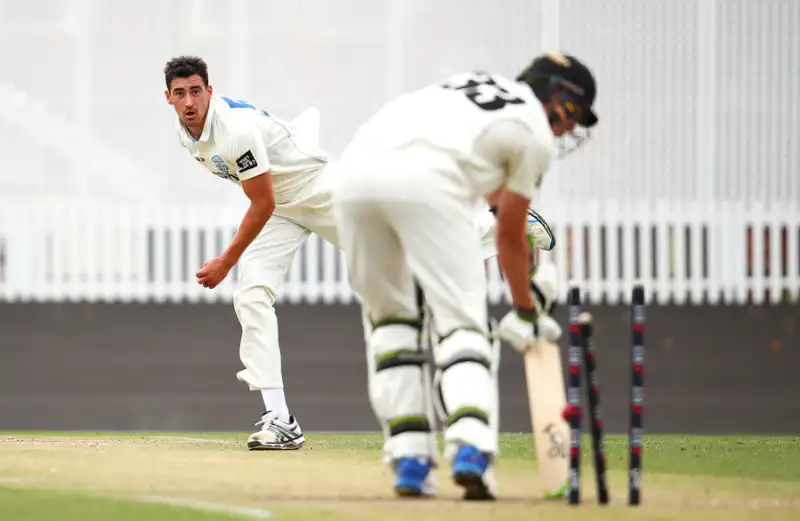
A hat-trick in cricket is one of the most exciting achievements a bowler can accomplish. It happens when a bowler takes three wickets from three consecutive valid deliveries, dismissing three different batters. All three wickets must be credited to the same bowler.
The feat can occur across two overs and even across innings in Test cricket. From Fred Spofforth’s historic achievement to Lasith Malinga’s incredible four wickets in four balls, cricket has witnessed some unforgettable hat-trick moments. Recent examples include Romario Shepherd’s T20 World Cup hat-trick in 2026 and Hasan Mahmud’s Test hat-trick against Afghanistan.
Let’s understand the rules, types, records and famous examples of hat-tricks in cricket.
What Is a Hat Trick in Cricket?
A hat-trick in cricket happens when a bowler takes three wickets from three consecutive valid deliveries, dismissing three different batters. All three dismissals must be credited to the same bowler.
It is one of the most exciting achievements in the game because it puts immediate pressure on the batting side and can change the direction of an innings.
A hat-trick does not have to happen in one over. The three wickets can come across two overs or even across the end of one innings and the start of another in a multi-innings match. The important condition is that the same bowler must take three wickets from three consecutive valid deliveries they bowl in the same match.
A wide or no-ball does not count as a valid delivery and does not interrupt the sequence of valid deliveries for this purpose. The next valid delivery continues the sequence.
For example, a bowler might take a wicket with the final valid ball of an over and then dismiss two more batters with the first two valid balls of the next over. That is a hat-trick.
The achievement is rare because the bowler must dismiss three different batters in succession, with every dismissal credited to them.
Hat Trick in Cricket: Rules Explained
A hat-trick follows a simple definition, but a few details matter when deciding whether a bowling performance qualifies.
1. Three consecutive wickets
The bowler must take three wickets from three successive valid deliveries they bowl. The wickets must be credited to that bowler and must involve three different batters.
2. The wickets can come across different overs
A hat-trick does not have to happen within six balls. A bowler can take a wicket with the final valid ball of one over and two wickets with the first two valid balls of the next.
The same principle applies if the bowler takes two wickets at the end of an over and the third with the first valid ball of the next over.
3. A hat-trick can cross innings in Test cricket
In Test cricket, a bowler can complete a hat-trick across two innings of the same match.
For example, a bowler could dismiss two different batters with the final two valid balls they bowl in the opposition’s first innings. If the same bowler then takes a wicket from the first valid ball they bowl in the second innings, the sequence qualifies, provided the third dismissal is of a different batter.
Merv Hughes achieved this unusual feat against the West Indies in 1988. He dismissed Curtly Ambrose and Patrick Patterson in the first innings before removing Gordon Greenidge with his first ball in the second innings.
4. Run outs do not count
The bowler must receive credit for all three wickets. A run out does not count towards an individual bowling hat-trick because the dismissal is not credited to the bowler.
For example, if a bowler takes a wicket, the next batter is run out, and the bowler then takes another wicket, it is not an individual bowling hat-trick.
5. No-balls and wides need special attention
A batter cannot normally be dismissed in a way that gives the bowler credit from a no-ball. Therefore, a wicket from a no-ball cannot be counted as one of the three wickets in a bowling hat-trick.
A wide is also not a valid delivery for the three-ball sequence. Neither a wide nor a no-ball breaks an existing hat-trick sequence. The next valid delivery continues the sequence.
These explanations follow the usual statistical convention for recording bowling hat-tricks. The MCC Laws define valid balls, wides and no-balls, but do not provide a separate law that formally defines a hat-trick.
For a hat-trick to count, all three wickets must be credited to the same bowler and must involve three different batters from three consecutive valid deliveries bowled by that player.
What Are the Types of Hat Tricks in Cricket?
Cricket has several unusual versions of the hat-trick. Some are individual bowling achievements, while others are informal terms used to describe a team’s performance.
1. Regular hat-trick
This is the standard achievement. A bowler dismisses three different batters with three consecutive valid deliveries.
The wickets can come through different dismissal methods, provided the bowler receives credit for each one.
2. Double hat-trick
A double hat-trick is an informal cricket expression generally used when a bowler takes four wickets from four consecutive valid deliveries. It is an even rarer achievement than a regular hat-trick.
It is also sometimes called a beaver-trick. The terminology is not an official category in the Laws of Cricket.
Lasith Malinga famously achieved four wickets in four balls twice in international cricket. His performances against South Africa in the 2007 Cricket World Cup and New Zealand in 2019 remain two of the best-known examples.
The term can sometimes cause confusion with two separate hat-tricks in the same match. Australian bowler Jimmy Matthews achieved the latter in a Test against South Africa in 1912, taking one hat-trick in each innings.
3. Team hat-trick
A team hat-trick is an informal expression. It describes three wickets taken by the fielding team from three consecutive deliveries, even if the dismissals are not all credited to the same bowler.
For example, a bowler could take a wicket, a batter could then be run out, and the bowler could take another wicket from the next delivery. This may be described informally as a team hat-trick because the fielding team has taken three wickets in the sequence.
However, it is not an official individual bowling hat-trick. The run out is not credited to the bowler and cannot count towards their personal hat-trick record.
4. Five wickets in five balls
Five wickets in five consecutive balls is an extraordinary bowling achievement. It includes a hat-trick within the sequence but goes beyond the usual three-wicket milestone.
Ireland’s Curtis Campher achieved this for Munster Reds against North-West Warriors in the Inter-Provincial T20 Trophy on 10 July 2025. He finished with 5/16 and became the first male cricketer to take five wickets in five balls in a professional match.
New Zealand’s Brett Randell achieved another major milestone on 8 March 2026. Playing for Central Stags against Northern Districts in the Plunket Shield, he became the first bowler to take five wickets in five consecutive balls in first-class cricket. He finished with figures of 7/25.
These achievements show how extraordinary bowling sequences can extend beyond the traditional hat-trick.
Famous Hat Tricks in Cricket History
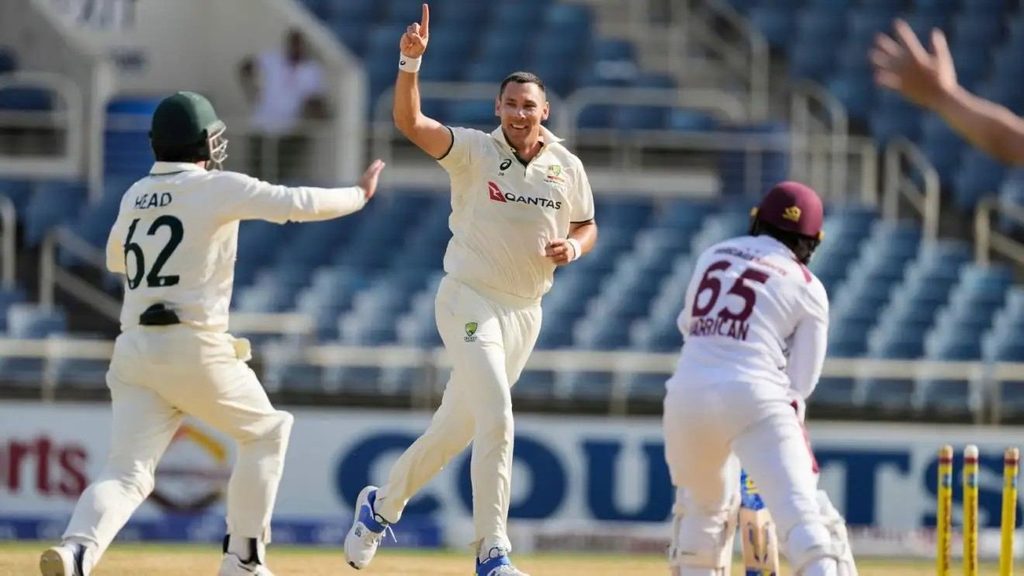
International cricket has produced several memorable hat-tricks. Some changed major matches, while others created records that still attract attention.
| Bowler | Country | Opponent | Year | Achievement |
| Fred Spofforth | Australia | England | 1879 | First Test hat-trick |
| Jimmy Matthews | Australia | South Africa | 1912 | Two Test hat-tricks in one match |
| Jalal ud-Din | Pakistan | Australia | 1982 | First ODI hat-trick |
| Chaminda Vaas | Sri Lanka | Bangladesh | 2003 | Hat-trick with the first three balls of an ODI |
| Brett Lee | Australia | Bangladesh | 2007 | First men’s T20I hat-trick |
| Lasith Malinga | Sri Lanka | South Africa and New Zealand | 2007 and 2019 | Four wickets in four balls twice |
| Romario Shepherd | West Indies | Scotland | 2026 | T20 World Cup hat-trick |
| Hasan Mahmud | Bangladesh | Afghanistan | 2026 | First Bangladesh fast bowler to take a Test hat-trick |
Fred Spofforth: The First Test Hat-Trick
Australian fast bowler Fred Spofforth became the first player to take a Test hat-trick in 1879. He achieved the feat against England at the Melbourne Cricket Ground.
Known as the Demon Bowler, Spofforth was one of Australia’s leading bowlers during the early years of Test cricket. His achievement became an important moment in the sport’s history.
The International Cricket Council recognises Spofforth as the first bowler to take a Test hat-trick.
Jimmy Matthews: Two Hat-Tricks in One Test
Australian bowler Jimmy Matthews achieved something extraordinary in 1912. He took a hat-trick in each innings of the same Test match against South Africa at Old Trafford.
Both hat-tricks came on 28 May 1912. He dismissed Rolland Beaumont, Sid Pegler and Tommy Ward in the first innings. In the second innings, he removed Herbie Taylor, Reggie Schwarz and Tommy Ward.
Matthews remains the only bowler to take two hat-tricks in the same Test match.
Jalal ud-Din: The First ODI Hat-Trick
Pakistan’s Jalal ud-Din became the first bowler to take an ODI hat-trick in 1982. He achieved the feat against Australia on 20 September in Hyderabad, Pakistan.
His three consecutive victims were Rod Marsh, Bruce Yardley and Geoff Lawson. He finished with four wickets for 32 runs.
This achievement established Jalal ud-Din’s place in ODI cricket history.
Chaminda Vaas: Three Wickets from the First Three Balls
Sri Lankan fast bowler Chaminda Vaas created history against Bangladesh during the 2003 Cricket World Cup.
He took three wickets with the first three balls of the match. Hannan Sarkar, Mohammad Ashraful and Ehsanul Haque were his victims.
Vaas then claimed another wicket in the same over. He finished with figures of six wickets for 25 runs, helping Sri Lanka win by ten wickets.
It remains one of the most remarkable opening spells in Cricket World Cup history.
Brett Lee: The First Men’s T20I Hat-Trick
Australia’s Brett Lee took the first hat-trick in men’s T20 International cricket on 16 September 2007.
He achieved the feat against Bangladesh during the inaugural ICC World Twenty20 in Cape Town. Lee dismissed Shakib Al Hasan, Mashrafe Mortaza and Alok Kapali in three consecutive deliveries.
Australia won the match by nine wickets. Lee finished with three wickets for 27 runs.
Lasith Malinga: Four Wickets in Four Balls
Lasith Malinga is famous for his unusual bowling action and deadly yorkers. He also holds the men’s international record for the most hat-tricks, with five.
His first famous four wickets in four balls came against South Africa during the 2007 Cricket World Cup. He removed Shaun Pollock and Andrew Hall with the final two balls of an over, then dismissed Jacques Kallis and Makhaya Ntini with the first two balls of his next over.
Malinga repeated the four-in-four achievement against New Zealand in 2019. He dismissed Colin Munro, Hamish Rutherford, Colin de Grandhomme and Ross Taylor in consecutive deliveries.
He finished that match with five wickets for six runs. Sri Lanka won by 37 runs.
Romario Shepherd: T20 World Cup Hat-Trick in 2026
West Indies all-rounder Romario Shepherd produced a memorable bowling performance against Scotland during the 2026 ICC Men’s T20 World Cup.
On 7 February 2026 at Eden Gardens in Kolkata, Shepherd dismissed Matthew Cross, Michael Leask and Oliver Davidson in consecutive deliveries during the 17th over to complete his hat-trick.
He also dismissed Safyaan Sharif in the same over, finishing with figures of five wickets for 20 runs. West Indies defeated Scotland by 35 runs.
Shepherd became the first West Indies player to take a hat-trick in the men’s T20 World Cup. It was also his second T20I hat-trick.
Hasan Mahmud: Bangladesh’s Test Hat-Trick in 2026
Bangladesh fast bowler Hasan Mahmud made history with a Test hat-trick against Afghanistan in October 2026.
He dismissed Ismat Alam, Qais Ahmad and Zia-ur-Rehman in consecutive deliveries. The achievement made him the first Bangladesh fast bowler to take a Test hat-trick and the third Bangladeshi bowler overall to achieve the feat.
His performance added another memorable chapter to Bangladesh’s Test cricket history.
Who Has Taken the Most Hat-Tricks in International Cricket?
Lasith Malinga holds the record for the most hat-tricks in men’s international cricket, with five. He took three in ODIs and two in T20Is.
Pakistan’s Wasim Akram is another leading name. He took four international hat-tricks, including two in Test cricket and two in ODIs.
| Bowler | Country | International Hat-Tricks |
| Lasith Malinga | Sri Lanka | 5 |
| Wasim Akram | Pakistan | 4 |
These figures refer to men’s international cricket. They do not include domestic competitions or franchise tournaments.
Hat-Tricks in Women’s International Cricket
Women’s international cricket has also produced several memorable hat-trick performances.
Australia’s Megan Schutt made history by becoming the first woman to take two international hat-tricks. Her first came in a T20I against India in March 2018. She took her second against West Indies in a women’s ODI in September 2019.
South Africa’s Masabata Klaas is another notable name. She took a women’s ODI hat-trick against Pakistan on 9 May 2019, dismissing Aliya Riaz, Omaima Sohail and Sidra Nawaz in consecutive deliveries.
These performances highlight the importance of hat-tricks in women’s international cricket as well as the men’s game.
Why Is a Hat-Trick So Special in Cricket?
A hat-trick is special because it combines skill, accuracy and pressure. A bowler needs to dismiss three different batters with three consecutive valid deliveries without allowing the sequence to break.
It can also change the match quickly. Losing three batters in consecutive deliveries puts a team under pressure, particularly when the wickets include important top-order players.
The achievement is equally memorable for spectators. A bowler on two consecutive wickets has a chance to create history with the next valid delivery. The fielding team often gathers around the bowler, while the crowd waits for the outcome.
A hat-trick can happen in Test matches, ODIs and T20Is. The format does not change the basic definition. Three consecutive valid deliveries bowled by the same player, resulting in wickets credited to that bowler and involving three different batters, are required.
Conclusion
A hat-trick in cricket is one of the most exciting achievements for a bowler. It requires three wickets from three consecutive valid deliveries, with every dismissal credited to the same bowler and involving three different batters. The feat can happen across overs and, in Test cricket, even across innings.
From Fred Spofforth’s historic achievement to Lasith Malinga’s five international hat-tricks, these moments have become an important part of cricket history. Recent performances by Romario Shepherd and Hasan Mahmud show that the achievement continues to create memorable moments in modern cricket.
Frequently Asked Questions
A hat-trick in cricket occurs when a bowler takes three wickets from three consecutive valid deliveries, dismissing three different batters. All three dismissals must be credited to the same bowler.
Yes. A bowler can take a hat-trick across two overs. For example, the final valid ball of one over and the first two valid balls of the next can produce a hat-trick.
No. A run out is not credited to the bowler. Therefore, it cannot count towards an individual bowling hat-trick.
Fred Spofforth of Australia took the first Test hat-trick against England in 1879.
Lasith Malinga of Sri Lanka holds the men’s international record with five hat-tricks. He took three in ODIs and two in T20Is.