

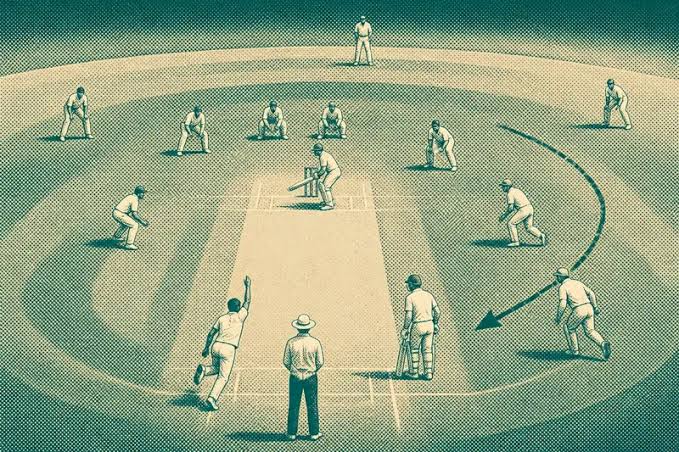
Cricket fielding positions can look confusing when you first watch a match. Commentators mention slip, gully, point, cover, midwicket and fine leg, often within the same over. Each name describes a particular area of the ground where a fielder stands.
Understanding these positions makes it easier to follow the game. You can recognise the captain’s plan, understand why a bowler is using a particular field and see which areas the batter is trying to target.
This guide explains the main cricket fielding positions, their locations and their roles. It also includes a printable cricket fielding positions chart for players, coaches, students and cricket fans.
Printable Cricket Fielding Positions Chart
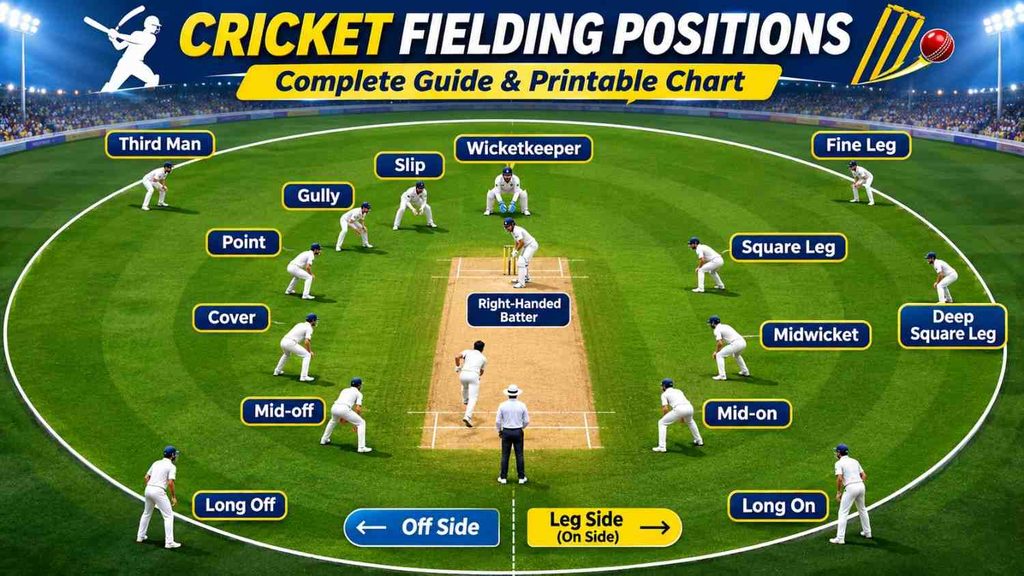
The cricket fielding positions chart is a reference diagram for a right-handed batter. It shows the main positions around the pitch, including close catchers, inner fielders and boundary fielders.
Use the chart to learn the names and approximate locations of different fielding positions. It is not a fixed field setting. Captains move fielders according to the bowler, batter, match format and playing conditions.
For a left-handed batter, the off side and leg side are reversed. The fielding arrangement should be viewed from the batter’s perspective.
How Are Cricket Fielding Positions Named?
Most cricket fielding positions are named using three basic ideas: the side of the pitch, the direction from the batter and the distance from the wicket.
1. Off Side and Leg Side
The off side is generally the side towards which the batter faces in their normal batting position. The leg side, also called the on side, is the opposite side.
Under MCC Law 36.3, the striker’s batting position when the ball comes into play determines the off side for that delivery.
For a right-handed batter, the off side is on the right when viewed from behind the striker looking towards the bowler. The leg side is on the left.
These sides are reversed for a left-handed batter.
2. Forward, Square and Backward
These words describe the direction of a fielder in relation to the batter.
- Forward: In front of the batter, towards the bowler.
- Square: Roughly level with the batter, at right angles to the pitch.
- Backward: Behind the batter, towards the wicketkeeper.
For example, cover is a forward position on the off side, while point is generally square of the wicket.
3. Close, Short, Deep and Long
These terms describe the distance and general location of a fielder.
- Silly: Very close to the batter.
- Short: Relatively close to the wicket.
- Deep: Far from the batter, usually near the boundary.
- Long: A straight boundary position, such as long on or long off.
For example, deep square leg is on the leg side, around square of the wicket and close to the boundary.
Main Cricket Fielding Positions and Their Roles
There are many named positions in cricket. Captains choose a combination based on the bowling plan, match situation and batter’s strengths. The following are some of the most common positions.
Close Catching Positions
Close fielders stand near the batter. Their main job is to catch edges, deflections and mistimed shots.
| Position | Location and role |
| Wicketkeeper | Behind the striker’s stumps. Takes catches, stumpings and run-out opportunities. |
| Slip | Behind the batter on the off side. Catches edges from the bat. |
| Second slip | Beside first slip, covering wider edges. |
| Third slip | Further away from the wicketkeeper in the slip cordon. |
| Gully | Wider and squarer than slip. Covers thick edges and cut shots. |
| Leg slip | Behind the batter on the leg side. Catches fine deflections. |
| Short leg | Close to the batter on the leg side, looking for bat-and-pad catches. |
| Silly point | Very close on the off side, usually forward of square. |
| Silly mid-off | Close to the batter on the off side, in front of square. |
| Silly mid-on | Close to the batter on the leg side, in front of square. |
Close catchers are particularly useful against spin bowling. They can also be placed against fast bowlers when the ball is moving and edges are likely.
Inner Ring Fielding Positions
Inner ring fielders protect the gaps between the close catchers and the boundary. They stop singles, prevent easy twos and create run-out opportunities.
| Position | Location and role |
| Point | On the off side, square of the wicket. Stops cuts and square shots. |
| Backward point | Behind point, covering shots played behind square. |
| Cover | On the off side, in front of square. Stops drives through the cover region. |
| Extra cover | Between cover and mid-off. Protects attacking drives. |
| Mid-off | Straight on the off side, near the bowler. |
| Mid-on | Straight on the leg side, near the bowler. |
| Midwicket | On the leg side, between mid-on and square leg. |
| Square leg | On the leg side, square of the wicket. |
| Short fine leg | On the leg side, behind square and relatively close to the batter. Protects against fine shots and deflections. |
These positions are important in every format. A captain may move cover closer to the batter to prevent a single or send the fielder deeper to protect against a boundary.
Boundary Fielding Positions
Boundary fielders stand near the edge of the playing area. Their main purpose is to stop fours and catch shots hit into the air.
| Position | Location and role |
| Third man (or deep third) | Behind the batter on the off side, near the boundary. |
| Deep point | Near the boundary on the off side, square of the wicket. |
| Deep cover | Near the boundary in the cover region. |
| Long off | Near the boundary, straight on the off side. |
| Long on | Near the boundary, straight on the leg side. |
| Deep midwicket | Near the boundary between long on and deep square leg. |
| Deep square leg | Near the boundary, square on the leg side. |
| Fine leg | Behind the batter on the leg side. Its exact depth depends on the field setting. |
| Deep fine leg (or long leg) | Near the boundary behind square on the leg side. |
Fine leg and deep fine leg describe related areas, but they are not necessarily the same fielding position. Short fine leg is used when the fielder is positioned closer to the batter, while deep fine leg or long leg describes a boundary position.
Boundary positions become especially important in limited-overs cricket. Batters often target gaps in the deep field to score fours and sixes.
How Many Fielders Are Allowed on the Cricket Field?
A cricket team has 11 players on the field while bowling. The bowler and wicketkeeper are included in this total. That leaves nine other fielders whom the captain can position around the ground.
The fielding arrangement must follow the Laws of Cricket and the playing conditions of the competition.
Under MCC Law 28, no more than two fielders, excluding the wicketkeeper, may stand behind the popping crease on the leg side at the moment of delivery.
Under the applicable ICC Men’s ODI and T20I Playing Conditions, there is also a restriction on the total number of fielders on the leg side. No more than five fielders may be on the leg side at the moment of delivery.
The laws also restrict fielders from encroaching on the pitch. Until the ball has made contact with the striker’s bat or person, or has passed the striker’s bat, no fielder other than the bowler may have any part of their person grounded on or extended over the pitch.
Rules About Fielder Movement
MCC Law 28.6, included in the 2017 Code, Fourth Edition (2026), deals with movement by fielders.
After the ball comes into play and before it reaches the striker, movement by a fielder other than the wicketkeeper is generally considered unfair.
The law allows certain exceptions. These include minor adjustments to a fielder’s stance or position, movement towards the striker by a fielder who is not a close fielder (provided the movement does not significantly alter their position), and movement in response to the batter’s stroke or intended stroke.
If a fielder makes an unfair movement, either umpire shall call and signal Dead ball. The batting side is awarded five penalty runs. An additional one-run penalty for a Wide or No-ball is also awarded if applicable.
These rules help ensure that fielders do not unfairly distract or disadvantage the batter.
Cricket Fielding Restrictions in T20 and ODI Matches
Limited-overs cricket has fielding restrictions that affect where captains can place their players. These restrictions are commonly known as powerplays.
The following figures apply to standard men’s international T20 and 50-over ODI matches under the applicable ICC Playing Conditions.
T20 International Fielding Restrictions
In a standard men’s T20 international, the first six overs are the Powerplay. Only two fielders can be outside the 30-yard fielding restriction area during this period.
After the Powerplay, a maximum of five fielders can be outside the restriction area for the remaining overs.
Men’s ODI Fielding Restrictions
In a standard men’s ODI, the restrictions are divided into three phases.
| ODI Phase | Overs | Maximum fielders outside the circle |
| Powerplay 1 | 1 to 10 | 2 |
| Powerplay 2 | 11 to 40 | 4 |
| Powerplay 3 | 41 to 50 | 5 |
What Happens If a Team Breaks Fielding Restrictions?
Captains must follow the applicable fielding restrictions throughout the innings. This includes the limits on fielders outside the restriction area and the maximum number of fielders allowed on the leg side.
If the fielding team breaches an applicable ICC fielding restriction, the umpire calls and signals a No-ball under the relevant Playing Conditions. The batting team receives the applicable No-ball penalty and any other runs scored from the delivery.
The exact restrictions can change in shortened matches and under competition-specific playing conditions. The updated ICC Playing Conditions effective from 1 October 2026 apply to international series beginning on or after that date. Series already in progress on that date continue under their previous conditions. The applicable rules should always be checked before setting a field.
How Captains Choose Fielding Positions
A captain does not place fielders randomly. Each position supports a particular bowling plan.
Against Fast Bowlers
Fast bowlers often use slips and a gully when they expect the ball to move away from the batter. Point, cover and mid-off protect the off side. Fine leg and square leg cover scoring areas on the leg side.
If the bowler is trying to make the batter play at deliveries outside off stump, the captain may keep several close catchers in the slip cordon.
Against Spin Bowlers
Spinners often use close catchers such as short leg, silly point and slip. These positions create opportunities for catches from edges and bat-and-pad deflections.
A captain may also place long on, deep midwicket or deep square leg to protect against attacking shots.
In T20 Cricket
T20 captains often use boundary riders to prevent sixes and fours. Deep point, deep midwicket, long on and deep square leg are common positions.
During the Powerplay, the two-fielder limit outside the restriction area makes placement especially important. Captains must balance wicket-taking positions with protection against boundaries.
Conclusion
Cricket fielding positions help explain how a team plans to take wickets and prevent runs. Close catchers look for edges and deflections, inner ring fielders protect singles, and boundary riders stop powerful shots.
Learning the names and locations becomes easier with a printable cricket fielding positions chart. Use the diagram as a reference, remember that the sides reverse for a left-handed batter, and check the match rules before using a particular field setting.
Frequently Asked Questions
The main positions include wicketkeeper, slip, gully, point, cover, extra cover, mid-off, mid-on, midwicket, square leg, fine leg and third man. Other common positions include deep point, deep cover, long on, long off and deep fine leg.
There are 11 players on the fielding team, including the bowler and wicketkeeper. The remaining nine players can be positioned around the ground, subject to the applicable rules.
The off side is generally the side towards which the batter faces in their normal batting position. The leg side is the opposite side. The striker’s batting position when the ball comes into play determines the off side for that delivery under MCC Law 36.3.
Point stands square of the wicket on the off side. Cover stands further forward, between point and mid-off. Both positions protect against shots played through the off side.
Fine leg describes a position behind the batter on the leg side. Short fine leg is closer to the batter, while deep fine leg or long leg is near the boundary.